Capabilities
Integrated engineering, from design basis to handover.
Twelve disciplines working from one design basis and one model. Engage a single discipline, or let us carry FEED and detailed engineering across all of them.
01 · PROCESS
Process engineering
System design for evaporation, ZLD, CO2 recovery, distillation and utility systems, developed to the level an EPC contractor needs to buy equipment and build.
- System design: evaporation, ZLD, CO2 and recovery plants
- PFDs, P&IDs and process datasheets
- Equipment process design and sizing
- Pump and line hydraulic calculations
- Fire-water system design
- Surge analysis
- Control and shutdown philosophy
- Cause & effect diagrams, safeguarding philosophy
- HAZOP / HAZID preparation and participation
- Operating and commissioning manuals
- Utility systems: steam, condensate, thermic oil, chilled, cooling and compressed air
- Technical bid evaluation and vendor document review
02 · MECHANICAL
Mechanical engineering
Static and rotating equipment engineering, from specifications and datasheets through to purchase recommendations and U-Stamp equipment design.
- Mechanical design basis
- Equipment specifications and datasheets
- U-Stamp equipment engineering
- Rotating equipment: agitators, pumps, compressors, centrifuges, fans and blowers
- Material handling: EOT and jib cranes, pig handling trolleys
- Tender specifications and bid evaluation
- Purchase recommendations
- Fitness for service to API 579-1 / ASME FFS-1
- Fatigue and fracture mechanics
- High-temperature creep and creep-fatigue assessment
- Troubleshooting and technical support on operating plants
- Turnover packages and dossier documentation
03 · STATIC EQUIPMENT
Static equipment design
This is our core discipline. We design pressure vessels, columns, reactors, heat exchangers, storage tanks, stacks and pig traps. The methodology follows ASME and TEMA and covers internals, externals, insulation, foundations, lifting and transport.
- Design calculations: ASME VIII Div. 1 & 2, PD 5500, EN 13445
- Storage tanks: API 650, API 620, API 653
- Heat exchangers and air coolers: TEMA, API 660, API 661
- GA and fabrication drawings, BOMs
- Columns: CDU, rectifier, recovery, degassing
- Separators, KO drums, filters, flash and reflux drums
- Fixed, floating and double tubesheet exchangers, kettles, condensers
- Self-supported and guyed stacks
- Nozzle load, lifting lug, saddle and skirt checks
- Wind and seismic analysis
- Existing-equipment validation for change of service
- Custom products: surge vessels, agitators, manholes, tank breathers
04 · PIPING
Piping engineering: process plant piping
Every item in the plant gets its space: equipment, structures, instruments and foundations. Pipe routes then connect them so that stress, operation and maintenance are all accounted for. This applies on both greenfield and brownfield plants.
- Piping design basis, specifications and calculations
- Plant layouts and GA drawings
- Full plant 3D modelling with structures and access platforms
- Isometrics with welding and testing details, spool generation
- Bill of materials
- Pipe rack design and detailing
- Primary and secondary support design
- Spring hangers, rigid hangers, expansion joints, struts
- As-built engineering from point-cloud data
- Site survey, red-lining and drawing updates
- Intelligent P&IDs and 2D drawing conversion
- Utility piping: steam, condensate, chilled, hot and cooling water
05 · PIPELINE
Pipeline engineering & pigging systems
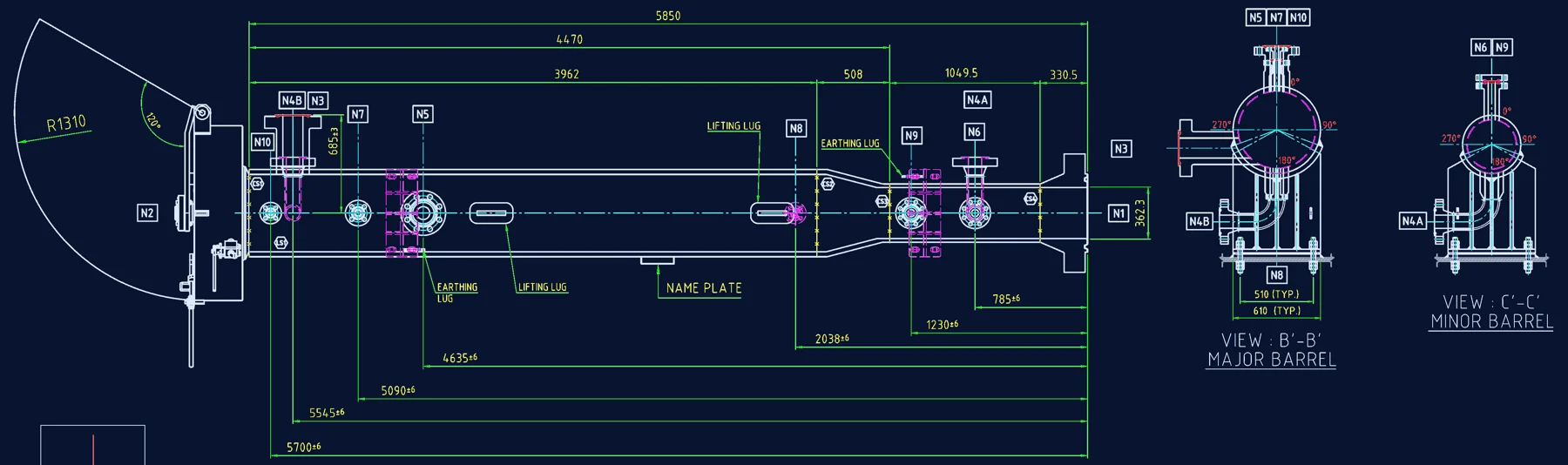
Pipeline engineering is a separate discipline from in-plant piping. It covers the long-distance cross-country and offshore lines that connect fields, plants and terminals, and the pigging equipment that keeps them clean and inspectable. We engineer pig launchers, receivers and bi-directional traps, with their quick opening closures, supports and handling equipment.
- Scraper traps from 6" to 64", 180 designed since 2017
- Launchers, receivers and bi-directional traps
- Design to ASME B31.4 / B31.8 and project specifications
- Barrels, eccentric reducers, kicker and balance lines
- Quick opening closure (QOC) and nozzle FEA
- Flange rating, branch reinforcement, hydrotest
- Sliding saddles, lifting lugs, jib cranes, pig handling trolleys
- GA and fabrication drawings with nozzle orientations
06 · ELECTRICAL & INSTRUMENTATION
Electrical & instrumentation
E&I engineering for skids, packages and plants, coordinated in the same model as equipment and piping. For fired heaters, we also provide burner management system (BMS) engineering.
- Power transformers, HT / LT panels
- Cable trays, raceways and complete cabling
- Bus ducts, wiring and power sockets
- Illumination and earthing systems
- HT & LT testing
- Fire detection and LAN
- Control systems and instrumentation for skids
- Burner management systems for fired heaters
- BMS P&ID review and installation philosophy
- Raw-water automation and instrumentation
07 · CIVIL & STRUCTURAL
Civil & structural engineering
Structural design for the steel that carries process equipment: skid frames, pipe racks, platforms and supports. We check it for operating, transport and temporary conditions.
- Skid structure design and analysis
- Harmonic and vibration response of skids
- Containerised skid support and reinforcement
- Pipe racks and pipe supports
- Equipment platforms and access structures
- Foundation loading data
- Temporary jacking and lifting checks
- Tank shell and bracket verification
08 · FEA / CFD
FEA & CFD analysis
We use simulation where code formulae do not cover the geometry or loading, or where a design change has to be proven before fabrication. The work runs in-house on Ansys Mechanical and Ansys Fluent.
- Linear static analysis of components and assemblies
- Geometric and material nonlinearity: plasticity, creep
- Fatigue: LCF / HCF and damage-tolerant models
- Modal, frequency and dynamic analysis
- Bolt preload and sealing-pressure analysis
- Elastomer and composite FEA
- Flow and pressure-drop studies
- Thermal and conjugate heat transfer
- Single and multiphase CFD, particle tracking
- Agitators and mixing, separators, cyclones
- Ducts, ESPs, bag filters, HRSG, burners and flares
- Surge tanks, column trays and flow distribution
09 · STRESS ANALYSIS
Pipe stress & flexibility analysis
Static and dynamic analysis of onshore and offshore piping connected to rotating equipment, exchangers, columns, reactors, tanks, flares and steam systems. We work in CAESAR II to ASME B31.1, B31.3 and the API standards.
- Stress design basis and critical line list
- Load cases for every operating scenario
- Equipment nozzle load evaluation
- WRC nozzle flexibility, branch SIF calculations
- Flange leakage and safety valve assessment
- Spring and expansion joint selection with datasheets
- Steam turbine piping to NEMA SM23
- HDPE, GRE, GRP / FRP, jacketed and buried piping
- AIV, FIV, fatigue and vibration evaluation
- Wind, seismic, wave, blast, slug and surge cases
- Offshore displacement and sea-transport analysis
- Pipe support design and special support drawings
10 · INSPECTION
Inspection & equipment integrity
Our NDT and inspection professionals check equipment during fabrication and in service. Where needed, the engineering assessment goes on to establish whether it is fit to keep running.
- Stage and final inspection during fabrication
- NDT coordination and review
- Process column inspection and rectification reports
- Equipment life assessment
- Fitness-for-service assessment
- Validation of existing equipment for change of service
- Expediting and quality surveillance
- Vendor and contractor pre-qualification
11 · VENDOR DOCUMENT REVIEW
Vendor document review & procurement support
An engineering check of what vendors and fabricators submit, plus support for buying and expediting. Price, material quality and supply-chain risk all matter on complex projects.
- Vendor GA, calculation and datasheet review
- Equipment nozzle load (ENL) and interface checks
- Comment resolution sheets (CRS) to closure
- Technical bid evaluation (TBE)
- Technical query (TQ) management
- Purchase specifications and recommendations
- Supplier pre-qualification
- Fabrication, purchasing and expediting support
12 · PROJECT MANAGEMENT
Project management
Project management sits at the centre of how we work. You get one point of contact who plans, coordinates the disciplines, controls change and reports progress until the project closes.
- Contract review and kick-off
- Milestones, planning and scheduling
- Progress tracking through periodic reviews
- Interdisciplinary coordination
- Risk identification, analysis and mitigation
- Cost control
- Change logs raised and approved
- Single point of contact for client and internal team
- Lessons learned captured and applied
- Project closure reports
Milestones
Equipment engineered since 2017.
Units designed by EnggDesign, with the largest single item in each category. Figures come from our project records.
Industries
Where our engineering runs.
The same discipline and code base, applied to the operating conditions of each sector.
Oil & gas
Onshore and offshore: separators, slug catchers, scraper traps, gas dehydration.
Refining & petrochemicals
Columns, reactors, exchangers, fired-heater BMS, flare-line analysis.
Fertilisers & chemicals
Heat exchangers, reactors and agitated vessels, process piping.
Ethanol & distilleries
Fermentation, distillation, evaporation and CO2 recovery plants.
Power & boilers
Steam and turbine piping, ducts, ESPs and HRSG flow studies.
Industrial refrigeration
Ammonia refrigeration, chilling plants and HVAC piping.
Water & ZLD
Water treatment, surge tanks and zero liquid discharge systems.
Food, pharma & sugar
Hygienic process vessels, tank farms and utility systems.
Codes and standards we design to
How we work
Concept. Analyse. Design. Deliver.
A fixed sequence on every job, so you always know what has been checked and what comes next.
Concept
- Understand what the project means to the client
- Review RFQ, specifications and raise technical queries
- Agree schedule and commitments
Analyse
- Assess the as-is state and constraints
- Check feasibility, function and code requirements
- Identify scope for improvement
Design
- Collect all design data and fix the design basis
- Calculate, model and verify by analysis
- Internal check against project checklists
Deliver
- Issue drawings, reports and datasheets
- Resolve client comments through CRS
- Inspection, documentation and handover
Talk to our engineering team
Have a datasheet, RFQ or a problem on the plant?
Send the scope, governing codes and schedule. An engineer, not a sales desk, reviews every enquiry.